Why is it that governments can decide to ban AI in schools, while others decide they need to implement AI literacies, and in one signing of a pen it’s done, but nothing gets signed that would fundamentally change why we learn? Why can’t we change curriculum, not to put sustainability in as a performative gesture, but to change why we learn?
Here’s the thing: The state can move, and that’s the whole point. It signs AI into the curriculum, or signs it out, fast, in one stroke. So the question isn’t how can we get the state, or the credentialing body, to enact changes in education, or why is it so hard. It’s why does it decide to do some things and not others? And the answer is that the state and the credentialing body are themselves so entangled in capitalism that they cannot move against it.
AI literacy is safe because it changes nothing fundamental. It’s the kind of safe that makes you think it’s disruptive, revolutionary, but really the grammar of schooling never changes: it’s still about individuals competing with one another. It’s still about optimising the sorting machine that is school. It’s about getting kids ready for the jobs of tomorrow, whether or not we know which exist.
Because ultimately it’s about preparing young people with the dispositions to be employable. It’s about building competencies in order for capitalism to capture them. This is what Gramsci called cultural hegemony, when power is maintained through consent.
AI disrupts assessment, they’ll say. It doesn’t. It disrupts the mode of assessment, not its purpose. You’re still looking for the same individual skills to get you ready to be a productive worker.
They will tell you it teaches critical thinking or that you should still teach critical thinking so that you know how to use AI correctly. But critical thinking is deprived of critique once it’s been captured: the method kept and even elevated, but the object dropped. Critique (cf. Frankfurt School) took the whole system as its object and asked what makes things sayable in the first place. Critical thinking evaluates the argument you have in front of you but makes invisible, unsayable, everything holding it up. The purpose of critical thinking is still about making sure you are not fooled, but only so you can come up with better answers, not make mistakes, and ultimately maximize productivity (even if just by reducing errors). If people really were taught critique, they’d see the system for what it is, that they’re being captured, appropriated, taken advantage of. That’s why the grammar doesn’t move: it can’t teach the thing that would undo it.
And eco-literacies? They sound like they might matter and those who implement them are knowledgeable and well-meaning, and I am not suggesting that we don’t teach eco-literacies. Let’s just make sure we don’t mistake it for a panacea. Eco-literacies are legible, and for this very reason, they won’t transform education. It’s the same sorting machine with a green coat of paint. Legible enough to be signed, which is why they get signed. But the moment ecological learning lands as an individual competency on a transcript, the sorting machine eats it right up. Green skills for green jobs, signed when it’s cheap and easy to do so, and as soon as they announce some national emergency it’s a drain and so they’re cut. Just ask the Arts. And when they don’t get signed, that’s a move too. Having eco-literacies on the table and refused makes them look like the radical edge. It fools us into misreading what radical is, so we stop looking for what really is radical. We reach for the centre and think we’re on the edges.
And this is where measurement comes in, because measurement is how the eating happens. Somebody decides what the ruler is. No, not one actor in a backroom, countless actors that make the system. Because someone always decides. A standardised test isn’t objective. Somebody picked those questions. Somebody valued what was worth measuring in the first place. Regenerative education rejects the idea that measurement is the final outcome, the ultimate measure of learning as if the measure was a whole, and above all else with somebody else deciding what the ruler is.
Some will say: if you don’t measure, how do you know learning is happening? The answer is you can’t, and that is the point. Measure comes from the root meh₁-, to measure, in the sense of marking out a bound. The same root gives us immense: in-mensus, that which cannot be measured. Measurement has always been about there being something past the ruler. Measurement is openly placing a limit on something, admitting that there is something beyond the limit we set. To measure is to notice, to attend. Even in quantum physics, to observe is to measure. So we don’t stop measuring. We stop pretending that what lies past the ruler can be known. This is where learning gets liberated, because we know it exists, it thrives beyond what we have bound.
And that is what regenerative means in the first place: not connecting with nature and not healing the planet, as if the planet were something outside us, a machine that needed repairing. Re-generative: generated again, born again. Gener- from the root ǵenh₁-, to beget, to give birth. Learning that has been liberated past the bound doesn’t disappear. It gets born again, and again, through others. Regenerative education asks a different question. It asks how we might contribute to community so that the learning gets born and lives on again and again. How we might participate in place, with human and other-than-human life, so that we open up to life-giving possibilities. Which means the capacities the grammar of schooling treats as ends, regenerative education treats as means. Means to contribute to those possibilities. All of it bundled into an experience, and it’s the growth through that experience that matters.
Why doesn’t the system reach for this? Education doesn’t live on its own, like some isolated piece. It’s wound into university, jobs, income, family, all sorting in the same direction, each defined by the others. My own daughter has to be legible to that machine. Of course she does. It sucks, and that’s not the exception, it’s the proof. And what emerges and unfolds from regenerative education doesn’t come in the form the next sorter reads, but it is still legible, as story. It is a shift but it is not a rupture, not yet at least. This is a diplomat’s move.
This can’t be done in one swift stroke. If it could, it wouldn’t be transformative, probably just re-form. It takes time and patience and finding spaces and it doesn’t require burning the place down. It also takes a whole lot of us to make these smaller and bigger moves in different places. So this isn’t a plea to the state, the state is the last thing to move. This is for anyone with a little room, the schools and the experiments and the distortions in the system, all those spaces where experimenting in the proper sense of the word can happen. Green School is one of those spaces. If there’s a crack, however small, you can move it, just a little.
Take L., in eighth grade. She spends her weekends and evenings helping the local Balinese dogs, so many of them sick, dumped, needing to be vaccinated or neutered. She raises money, works with adults, makes little pouches from sustainable materials to carry Bravecto, so when you see a dog with mange you can treat it. But making that pouch isn’t solving anything. She isn’t changing the world. She’s doing a little bit to contribute to other people, and to how they might help others. She’s an eighth-grader working with adults, working with their kindness so that it continues, a whole network of kindness, her work resonating in ways that augment what others do. It goes beyond her.
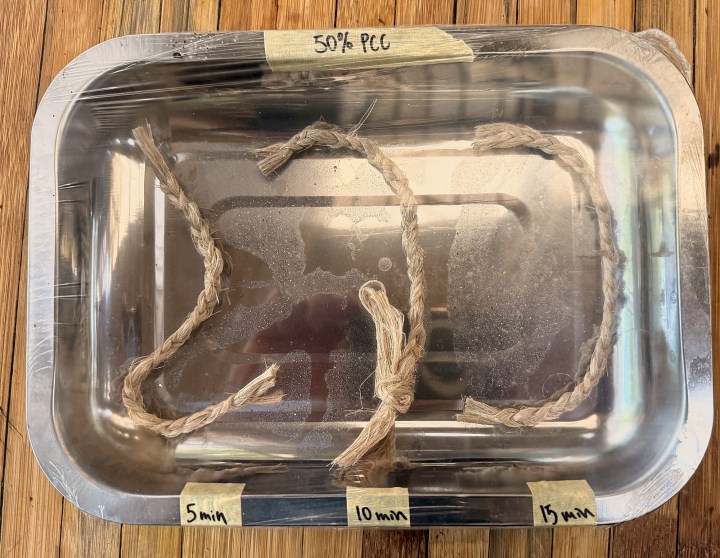
Or M., in twelfth grade. She’s working on a biodegradable fishnet. The bioplastic substitutes out there still pollute the water when they dissolve, so she’s making hers from banana fibre, working out how to make it hydrophobic, blending it different ways. Will she succeed? I don’t know, there is no net right now. There are three lengths of banana-fibre cord in a stainless tray under cling film, masking tape torn by hand and marked in biro: five minutes, ten minutes, fifteen minutes. But she goes to the lab during class time, during her spare time. She’s determined. She means to do well for the ocean and for the farmers. She isn’t trying to commercialise it, isn’t following a process journal, just goes in and does her thing. And here’s the thing about that net: she’s not working with the kindness of people. She’s working with the fish. If it works, it goes in the ocean and she won’t know what happens next. The plastic that stays out of the water is somewhere else entirely, another part of the world, oceans she’ll never see. It goes beyond her, and it goes beyond the human.
Neither of them is legible on a transcript. What M. is showing isn’t a competency you can tick off. It’s a disposition, an approach. Determination, resilience, robustness. The net is the excuse for her to grow into someone who keeps going on that trajectory. And what L. is showing is love for the animals, and it’s not about her. None of that fits in a grade. So the legibility isn’t the badge or the grade. It’s the story. Those are the real stories of learning, not measurement points. And frankly, those stories tell me more about someone, and whether I’d want to work with them, than any grade on an English paper.
A story isn’t objective. So what? Neither is the test. And the story knows its own bound, that it has characters and ups and downs and details it omits. It also knows that it speaks to the mind and the heart. It knows that stories themselves strengthen relationships and move us to change. No test can do that. When was the last time you lost yourself in an exam score?
Learning is liberated when it is born and re-born through others. It’s not about you. It’s about how you deepen reciprocity, in the relationship between you and someone or something else, and how that deepens relationships beyond you. What matters is the ripples it reaches and the reciprocity it deepens. It’s something you don’t control, in the best way. It loosens, it goes out into the world. Not set free, liberated. Because it’s undocumented, it’s uncapturable. No one knows. It flows into a confluence with other people and their learning until it’s no longer traceable to you. You still left your mark, but we can’t find where, because it’s all mixed up with everyone else’s marks. The richest kind of learning, the one that does the most, is the one that can’t be traced. You don’t know who did it. It’s launched into the world. It implicates and moves other people, and it’s out there, being born again in them, in forms you may never recognise as what was yours, but you have left your mark, just like someone left their mark on you. Sometimes the ends are beyond you, and you’ll never know, and no one will ever know, because you’ve had an effect on others that can’t be traced back. And that’s regenerative. It was never meant to be something you frame or stick on the fridge, intact and immobile. It was taken in and turned into something else, which is the only way anything lives on. That’s metabolic.
Some people will say this isn’t achievable. Others will say that if you can’t know, you can’t call it learning, certainly not valuable learning. But that’s not the question. The question is whether we’re willing to let learning go, liberated to go past the documentation, past the point of measurement, beyond ourselves where we’ll never know what comes of it.

