
• Ph.D., History – National University of Singapore (2013)
• MSc, Education – Mercy College (2015)
• MBA, International Business – Thunderbird School of Global Management (2000)
• MA, International Relations – University of Denver, Joseph Korbel School of International Studies (1997)
• BA, International Affairs – Lewis & Clark College (1995)
• Post Graduate Diploma, Leadership – Emeritus Institute of Management (2021)
• Post Graduate Diploma, Design Thinking and Innovation – Emeritus Institute of Management (2020)
Bio
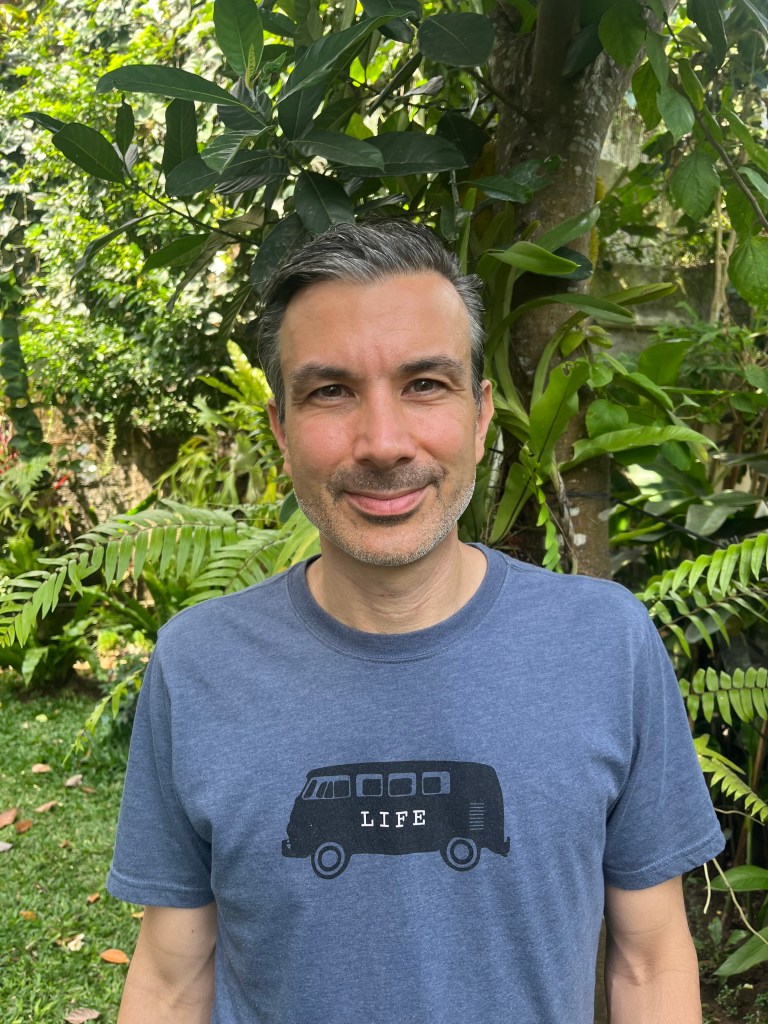
Dr. Benjamin Freud is an educator, learning dialogist, writer, and podcaster. He is the co-founder of Coconut Thinking, an advisory that helps and supports educators nurture learning ecosystems grounded in relationships that contribute to the thriving of the bio-collective—any living thing that has an interest in the healthfulness of the planet.
Benjamin is the Head of Upper School and Strategic Lead,Regenerative Education at Green School Bali, where he oversees the Middle and High School learning programs. He currently leads the design and implementation of the school’s Biomimicry for Regenerative Design (BiRD) curriculum, a first of its kind approach in K-12 that creates learning experiences in service of Life.
Before joining Green School, Benjamin was the Whole School Director of Teaching and Learning at an IB World School in Thailand and held senior leadership roles in progressive schools in Saudi Arabia and Hong Kong.
Benjamin began his career in the late 1990s as a consultant for internet start-ups in Silicon Valley, an experience that shaped his belief in the power of education, innovation, and entrepreneurship to positively impact people and the planet.
Benjamin holds a Ph.D. in History, an MSc in Education, an MBA, and an MA in International Relations.
Values
• Learning&Doing should always be in service of Life
• Flattened hierarchies
• Less us, more them.
• Schools should be communities of learners, built on relationships and respect.
• Life is about embracing challenges and new experiences.
• “Meaning and fulfillment are the new wealth. Contribution is the only way to accumulate it.” —Joanne McEachen
• “No act of kindness, no matter how small, is ever wasted.” —Aesop
Value Statement
Here is the (re)school Sprint 22 Sparkling Insight talk I gave, that I believe is a solid encapsulation of my values and approach. It will serve as well as any statement.
Learning Philosophy & Ethos
I was born and raised in Paris, France, and since 1989 have lived in the US, the UK, Japan, Singapore, Hong Kong, and now Saudi Arabia. I started my career in consulting before transitioning into education, where I worked with internet start-ups in Silicon Valley in the late 1990s. I was hired by individuals who were literally changing the world. I continued my consulting work in London and Tokyo, expanding into FMCGs and financial services. This experience gave me a unique insight into how schools can prepare learners to succeed in the world beyond school. It also provided me with the experience and confidence to innovate and meet learners’ individual needs.
Recently, I have been thinking quite a bit about the challenges we face, including ecological breakdown, socio-economic injustice, and how we treat each other and all other living things. I am increasingly interested in post-humanism, specifically the framework that breaks down binaries such as you/me, us/them, and humans/nature. I believe that the binary within ourselves is also false and that we cannot separate the cognitive from the affective, just like we cannot separate the self from the social. This is not a new age concept, but rather the idea that we need to move beyond humanist dualism to embrace ways of thinking and action that serve all living things.
I believe we should move away from an anthropocentric worldview (where humans are at the center) to a bio-centric worldview (where life is at the center). This means that we should have a set of ethics and purpose that direct our thinking and actions to maximize positive impact for the welfare of the bio-collective—all living things that have an interest in the healthfulness of the planet. Simply put, we need purpose to give our actions meaning, and that purpose should be the bio-collective. Otherwise, we’re just doing more of the same.
I want to create and nurture ecosystems where school extends beyond its physical and conceptual walls, where all members of the learning community live the ethics that will re-direct the course of history away from ecological and socio-economic catastrophe. Alongside future-ready skills, we should teach future-saving ethics such as “practice eco-reciprocity,” “stand up for justice,” “share with solidarity,” and “act with kindness.”
My pedagogical philosophy rests on the belief that deeper learning can only occur when it is meaningful to the learner. This deceptively simple phrase is in practice a complex web of processes. Meaning, by definition, is personal. It involves not only relevance to the learner but also accessibility and interest based on the right level of challenge at the right time. It naturally encompasses purpose and joy. Learning takes place in solitary or social settings, and I believe that the role of a school community is to activate and nurture learning through the cultivation of curiosity, empowerment, and relationships.
I take a constructionist approach to learning, one that, in the words of Seymour Papert, believes that “the best way to learn is to build something tangible—outside of your head—that is personally meaningful” (Papert, 1990). Learning is the result of one’s interactions with the world and the opportunities to apply new competencies and knowledge to different contexts. Learners learn best when they operate independently, guided through sets of challenging and enriching experiences by a more seasoned individual (the teacher, who is just a more experienced learner). Such contexts provide learners with the opportunity to acquire learning and apply it at the same time, cementing understanding and making it transferable to other contexts, which is evidence of learning. This is the apprenticeship model of learning.
I believe in constructionism, but also ecological reconstructionism: a shared purpose to ensure we learn and respond for the healthfulness of the bio-collective.
Most Meaningful Life-Long (Professional) Learning Experiences
Bio-Leadership Fellow
The Royal Society for the Encouragement of Arts, Manufactures and Commerce Fellow
Beyond Systems Thinking—ETH Zürich
Worldviews – Moving from Sustainability to Regeneration—ETH Zürich
Project Zero: Teaching for Understanding—Harvard Graduate School of Education (4 month course)
Project Zero: Classroom—Harvard Graduate School of Education (1 week at Harvard)
Project Zero: When Thinking Becomes Routine—Using Thinking Routines as More Than Activities—HGSE
Ron Ritchhart: Cultures of Thinking—Harvard Graduate School of Education (2 day course)
The PBL Practioner: Master Project Design Skills—PBL Global (20 hour course)
The PBL Facilitator: Be in Tune with Learners—PBL Global (20 hour course)
The PBL Change-maker: Reimagine PBL with Passion-Driven Projects—PBL Global (20 hour course)
Several IB certificates (cats 1,2,3)
Launching Innovation in Schools—MITx
Coaching Skills for Managers Specialization (4 modules)—University of California, Davis
Introduction to Computational Thinking for Every Educator—ISTE/Google
Adaptive Schools—Thinking Collaborative
Cognitive Coaching—Thinking Collaborative
Yoga Teacher: 200-hour certificate (RYT-200)
Publications
Academic Honors & Awards
• Emeritus Scholar Distinction in the Postgraduate Diploma in Leadership, awarded to the highest achievers in the entire program.
• Recipient of a Research Scholarship at the National University of Singapore, including full tuition and monthly stipend.
• Winner of the Graduate Students’ Teaching Award for Semester I 2009-2010 rec-ogniz-ing excellence in teaching for the entirety of NUS’s Faculty of Arts and Social Sciences. I was the award’s first recipient ever as 2009/10 was its inaugural year.
• Winner of the Png Poh Seng Prize, 2008-2009, awarded to the student in NUS’s History Department with the best average grades for all modules taken in a given academic year (only year I was eligible).
• Recipient of full scholarship to Thunderbird School of Global Management.
 Coconut Thinking